Steel vs timber sheds: which should you choose?
Get a Quote
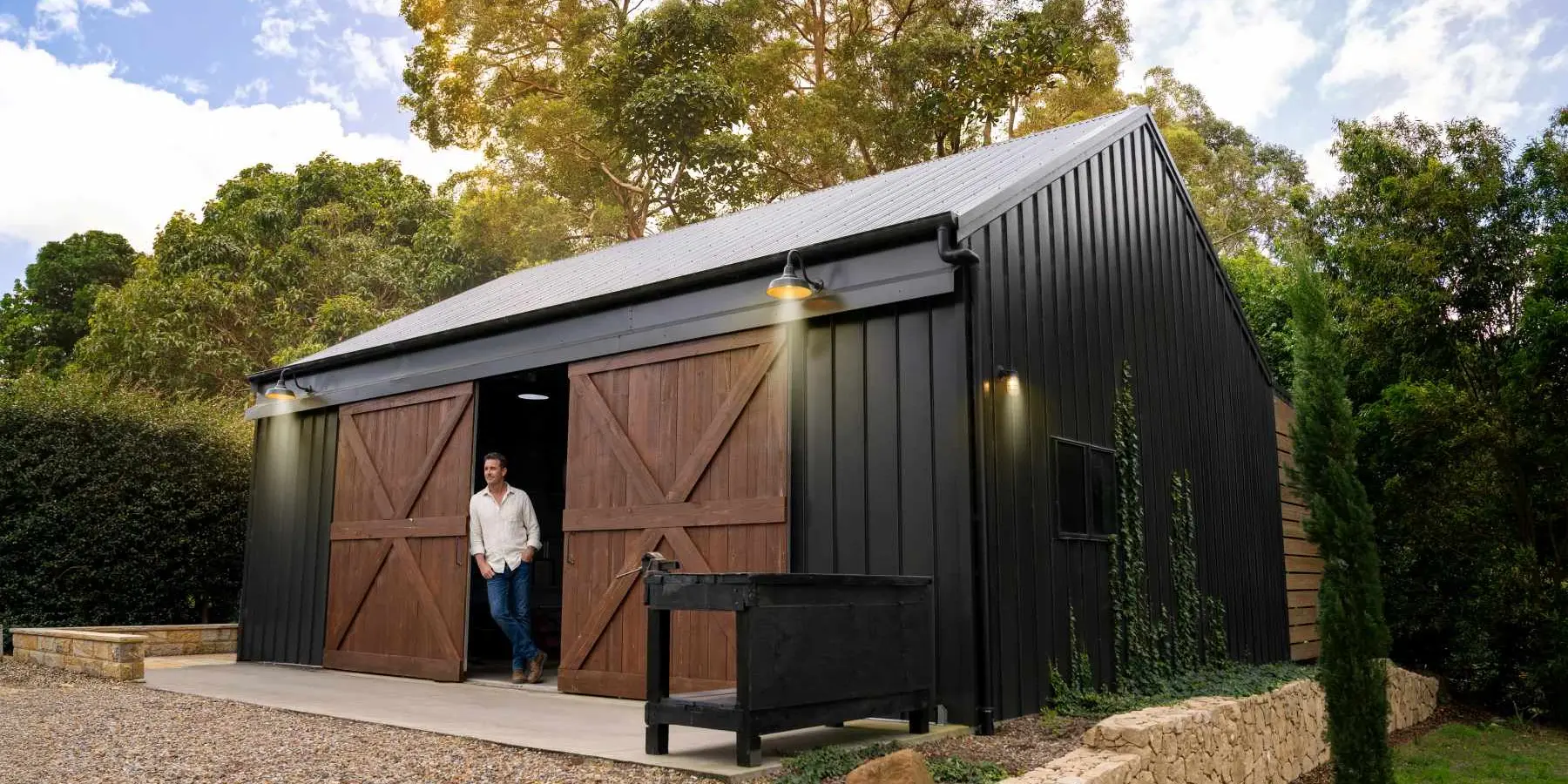
Steel or timber? It's a question that comes up on almost every shed build. There isn't one answer that works for every shed. A flat-pack shed that’s going to be tucked against the back fence has very little in common with a 12-metre workshop that has to hold a car hoist for the next 40 years. Yet they're often thrown into the same comparison. What makes sense for one can be completely wrong for the other, so the better place to start is with the shed you're actually planning to build.
How shed size and purpose change the steel vs timber decision

Size makes a big difference, but it's something people often overlook. For a shed under 6 square metres, there isn't much separating timber and steel on either cost or looks. The framework doesn't have much to bear at such a small size, and for just storing a lawnmower and a few tools, either one will do fine.
Once the shed gets bigger than a single bay, things change. A timber frame needs more posts and heavier sections to span a larger distance, and that will begin to take up space on the floor, as well as adding to the price. Steel can span the same distance using a much lighter frame. This is why Australian steel is so commonly used for sheds designed for caravans or large machinery.
What you plan to do inside the shed matters just as much. Most DIY tools don't ask much of a structure. Farm machinery, a working business or even a home gym is another story, with more being asked of the frame and wall sheeting. You may also need extra height for a hoist or wider openings to get equipment in and out. Our guide to workshop sheds goes into what to consider when you're planning for those uses.
Sheds in rural areas are generally larger, and this is where the use of timber starts becoming problematic from a cost perspective. Machinery sheds and hay sheds require wide-open areas inside without any obstructions from posts. The same goes for stables and farm workshops. Steel makes those wider, clear spans much easier to achieve. Our rural and farm shed range gives you an idea of what these larger builds usually involve.
Which lasts longer in Australian conditions, steel or timber sheds?

Steel sheds outlast timber sheds in most Australian environments, though the size of the gap depends on which threat your site actually faces. Timber's biggest threats are termites, rot and moisture, while steel has corrosion to contend with especially closer to the coast where coating of the steel is important to protect against coastal salt content. Which one matters most depends on where you're building.
Termites, rot and moisture

Termites are active across most of mainland Australia, with the heaviest pressure through Queensland, northern New South Wales, the Top End and pockets of Western Australia. Timber frames in those zones need treated pine or hardwood, along with termite protection and regular inspections. Steel frames are termite-proof outright, so that recurring cost disappears from the equation.
Moisture does the slower damage. Timber posts sitting on a concrete base wick water upward, and rot starts inside the post where nobody can see it. Steel doesn't rot, though the base detail still matters, so water drains away instead of pooling against the frame.
Bushfire risk and non-combustible materials

Steel doesn't burn, which gives it an obvious advantage once bushfire requirements start affecting the build. Australian sites are assigned a Bushfire Attack Level (BAL) rating from BAL-LOW through to BAL-FZ, and the rating drives what you're allowed to build with. Timber can be used at lower ratings, but at BAL-29 and above, you're into fire-retardant treatments, bushfire-resisting timber species, sealed gaps and stricter certification, all of which add cost and paperwork.
Coastal salt air and corrosion

Steel isn't automatically the right answer near the coast, either. Salt-laden air corrodes standard coatings, and a shed specified for an inland block will show rust at the fixings and cut edges within a few years if you drop it 500 metres from the beach.
The fix comes down to specification rather than material. Coastal builds need a higher-grade coating and matched fasteners, which is why your local Fair Dinkum Builds team asks where the site sits relative to breaking surf before quoting anything. Timber near the coast has its own problem, since salt-laden moisture accelerates the paint failure and swelling cycle. Neither material is a set-and-forget choice in a marine zone.
Heat, storms and harsh weather

Steel holds its shape through heat and doesn't warp or swell as the seasons swing. Timber moves with moisture and temperature, which is why doors that closed cleanly in June start binding in January.
Wind is where engineering separates a shed that stands up from one that doesn't. Every site falls into a wind region, and that classification determines post sizing, footing depth, bracing and how the roof sheeting is fixed down. Our breakdown of shed wind ratings explains how those regions work and what they mean for your build.
Steel vs timber shed costs: upfront price versus lifetime cost

Timber sheds often look cheaper on day one. Small kits in particular undercut steel because the material is thinner and the structure is simpler, and that's a genuine saving if the shed only needs to last a decade.
The bigger difference shows up over time. Timber needs recoating roughly every three to five years in exposed positions, and a full repaint or restain on a mid-sized shed runs into hundreds of dollars in materials plus a weekend of work each cycle. Over 30 years, that's six to ten repaint cycles, before you count replacing rotted boards or treating for termites.
Steel sheds carry a higher material cost upfront and then flatten out. Modern coatings are warranted for decades, so the ongoing spend across the same 30 years is close to nothing beyond the occasional wash-down. Our full breakdown of shed prices sets out what different sizes cost, so you can run those numbers against your own site.
Foundations shift the maths too. Both materials perform better on a concrete slab, and once you've paid for the slab, the relative cost of the structure sitting on top narrows.
How much maintenance do steel and timber sheds need?

Steel sheds need a hose-down a few times a year and little else, while timber sheds need active upkeep to stay sound. That difference compounds across the life of the build.
Timber upkeep runs on a cycle. Strip and recoat exposed surfaces before the finish breaks down, check for rot at the base and around windows, re-seal joinery, and maintain the termite barrier. Miss a cycle in a wet climate, and you're repairing rather than maintaining.
Steel upkeep is largely about keeping salt and fertiliser residue off the sheeting. Rinse the walls after a dry spell in coastal or agricultural areas, then touch up any deep scratches that expose bare metal. Ensure wall sheeting is clear of debris or landscape matter to avoid corrosion and rusted sheet issues.
Are timber sheds better insulated than steel sheds?

Timber has better natural insulation than bare steel, since wood conducts heat far more slowly. On an uninsulated build, a timber-framed shed will hold a slightly more stable internal temperature than a bare steel one on the same block.
That advantage disappears the moment either shed is properly insulated. Anti-condensation blankets and bulk insulation can both be incorporated into a steel shed without difficulty, and an insulated steel shed can outperform an uninsulated timber one. Given that any shed used as a workshop or home office needs insulation regardless of frame material, the natural insulation argument mostly applies to structures nobody spends much time inside.
Which shed material should you choose?

Choose steel if the shed needs to last, span more than a single bay, or you're building in an area where termites or bushfire requirements are a concern. Choose timber if the build is small and sheltered and its looks matter more than its lifespan, provided you're comfortable with a maintenance routine for the life of it. Timber offers installation advantages, allowing on-site cutting and fabrication to improve buildability. In contrast, steel is typically supplied in fixed lengths, making ad hoc adjustments that slightly more difficult.
For larger sheds and workshops, steel is usually the more practical choice in Australian conditions. Whether you want a kit delivered to the site or a builder to handle the lot, your local Fair Dinkum Builds team can take on as little or as much of the job as you need. If you're weighing up doing the assembly yourself, the shed kits range shows what comes in the package. Request a quote, and we'll work through your site, your size, your budget and your timing.
Frequently asked questions
Both are durable options, but COLORBOND® tends to be the more popular choice for residential sheds. While ZINCALUME® uses an aluminium-zinc coating and is left with its natural metallic finish, COLORBOND® has a baked painted coating on top of the steel. That offers you better protection against corrosion and a choice of around 20 colours to suit your home. ZINCALUME® is usually a bit cheaper and has better heat reflection properties. Most people choose COLORBOND® sheds for the appearance and the longer coating warranty.
You can usually get a shed to work well with your home by choosing the right colour, even though the texture won't be an exact match. There are many options available for COLORBOND®, including Paperbark®, Dune®, Bluegum® and Woodland Grey®, which will help you to create a design that looks more organic. The Unicote Lux sheeting range available through our supplier offers realistic timber-grain finishes, providing customers with the aesthetic appeal of natural timber while retaining the superior durability, low maintenance, and long-term performance benefits of high-quality steel. The shape of the structure is also very important. Certain features, like the gable roof or awning, can often do more to tie the shed into the house than the wall material itself.
Yes. Without insulation, a steel shed would be noisier during heavy rains compared to a wooden shed. If this is something that could be a concern for you, you could install an anti-condensation blanket underneath the roofing material. This not only dampens the noise but also prevents condensation from dripping into the shed. For a shed you're planning to use as a workspace, full insulation is usually the better option because it addresses both issues.
Smaller shed kits can be put together yourself if you're confident with this kind of work and have someone to give you a hand. However, when it comes to bigger or higher sheds and designs that require engineered footings, it is best done by a qualified builder. Your local Fair Dinkum Builds team offers both kit supply (with a supported installation guide) and complete builds, so you can decide how much of the project you want to take on yourself.
Most residential steel sheds take between 6 to 12 weeks after the quote is accepted, which includes obtaining council approval and waiting for the slab to cure. The actual construction time period is only a few days. Our article on how long a shed takes to build breaks the timeline down stage by stage.
A well-built steel shed will add more value to the property since the purchaser views it as an asset that already exists and not something that needs fixing up. The slab, electricity, height, and access through the doors mean more to a valuer than the frame material.
Approval usually depends on the size and location of the shed rather than whether it is steel or timber. Larger structures and those close to a boundary generally need approval, while some smaller sheds are exempt. The rules vary by state and territory, so check the guide that applies where you are building: